Tools to think like a behavioural scientist
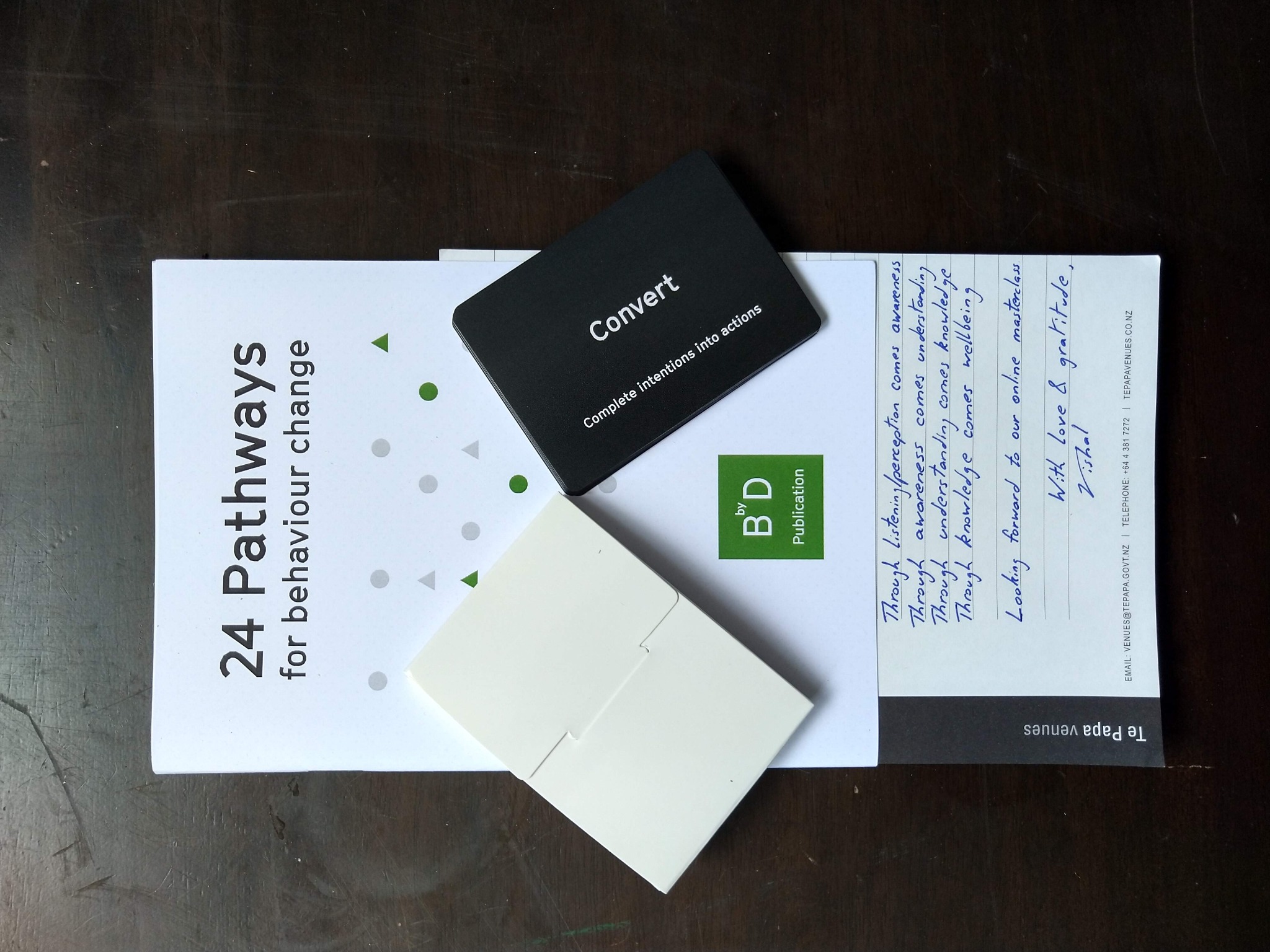
24 Pathways for
Behaviour Change
Flip a card to see the pathway for change, backed with research, and thought starters to generate ideas.
Behaviour change strategies for your AI agents
A-side · change the choice architecture
B-side · change the social context
All 24 pathways · use for idea generation with an AI agent
C
Capability
What skills and knowledge will help the individual perform the desired behaviour?C1
Ambiguity Aversion
We favour choices that we know over vague and uncertain choices.
C2
Choice Overload
We avoid making decisions when presented with too much information.
C3
Commitment Device
We are more likely to adopt a behaviour when we make a private or public promise.
Baca-Motes, K et al. (2012). Commitment and behavior change: Evidence from the field.
Read Pathway →C4
Empathy Gap
We underestimate the impact of our hot-states and cold-states on our behaviours.
Sayette et al. (2008). Exploring the Cold-to-Hot Empathy Gap in Smokers
Read Pathway →C5
Psychology of Chunking
C5 · Psychology of Chunking
We find it easier to process information when it is split into smaller parts.
Miller (1956). Some limits on our capacity for processing information
Read Pathway →C6
Implementation Intention
C6 · Implementation Intention
We act on our intentions only when we have a clear plan of action.
C7
Present Bias
We prefer smaller rewards in the present over larger rewards in the future.
Milkman, K. L. et al. (2010). I'll have the ice cream soon and the vegetables later
Read Pathway →C8
Self-Reference Effect
C8 · Self-Reference Effect
We respond to information when it is made more specific to us.
Team, B. I. (2014). EAST. Four Simple Ways to Apply Behavioural Insights.
Read Pathway →O
Opportunity
Who are the people shaping behaviour? How does the environment change behaviour?O1
Default Effect
We tend to follow the path of least resistance when making decisions.
O2
Authority Bias
We are heavily influenced by who communicates the information.
Bushman, B. J. (1984). Perceived Symbols of Authority and Their Influence on Compliance.
Read Pathway →O3
Framing Effect
We make choices based on how the information is presented to us.
Turnwald et al. (2017). Between Indulgent Descriptions and Vegetable Consumption.
Read Pathway →O4
Priming Effect
We are influenced by subconscious cues, such as, sights, language, sounds and smell.
Holland et al. (2005). Smells like clean spirit: Nonconscious effects of scent on cognition and behavior.
Read Pathway →O5
Halo Effect
We are easily influenced by someone or something with a positive reputation.
Chandon, P. et al. (2007). The biasing health halos of fast-food restaurant health claims. Journal of Consumer Research
Read Pathway →We are attracted to what seems novel and relevant to us.
Dolan et al. (2010). MINDSPACE: influencing behaviour for public policy.
Read Pathway →O7
Social Norms – Descriptive
O7 · Social Norms – Descriptive
We are heavily influenced by what we believe others do.
Cialdini (2003). Crafting normative messages to protect the environment
Read Pathway →O8
Social Norms – Injunctive
O8 · Social Norms – Injunctive
We are influenced by what we believe is socially acceptable behaviour.
Schultz et al. (2007). The constructive, destructive, and reconstructive power of social norms.
Read Pathway →M
Motivation
How do habits, goals, and incentives — intrinsic and extrinsic — impact behaviour?M1
Endowment Effect
When we have ownership over something, we place a higher value on it.
Kahneman (1990). Experimental tests of the endowment effect and the Coase theorem.
Read Pathway →M2
Consistency
We are driven to maintain a positive and consistent self image.
M3
Goal-Gradient Effect
M3 · Goal-Gradient Effect
We put in more effort when we see that we're getting closer to our goal.
Nunes et al. (2006). Your loyalty program is betraying you
Read Pathway →M4
Goal Dilution
We believe something is more effective when it has just one clear benefit.
M5
Reciprocity
We respond positively to small gestures of kindness and generosity.
Strohmetz et al. (2002). Sweetening the Till: The Use of Candy to Increase Restaurant Tipping
Read Pathway →M6
IKEA Effect
We like things more when we build them ourselves.
Norton, M. I., et al. (2012). The IKEA effect: When labor leads to love
Read Pathway →M7
Loss Aversion
The pain from losses is more powerful than the pleasure from gains.
M8
Variable Rewards
We are more motivated by surprise rewards than fixed rewards.
Shen, L., et al. (2014). The motivating-uncertainty effect
Read Pathway →